
What Is Tumor Biobanking and Why Does It Matter
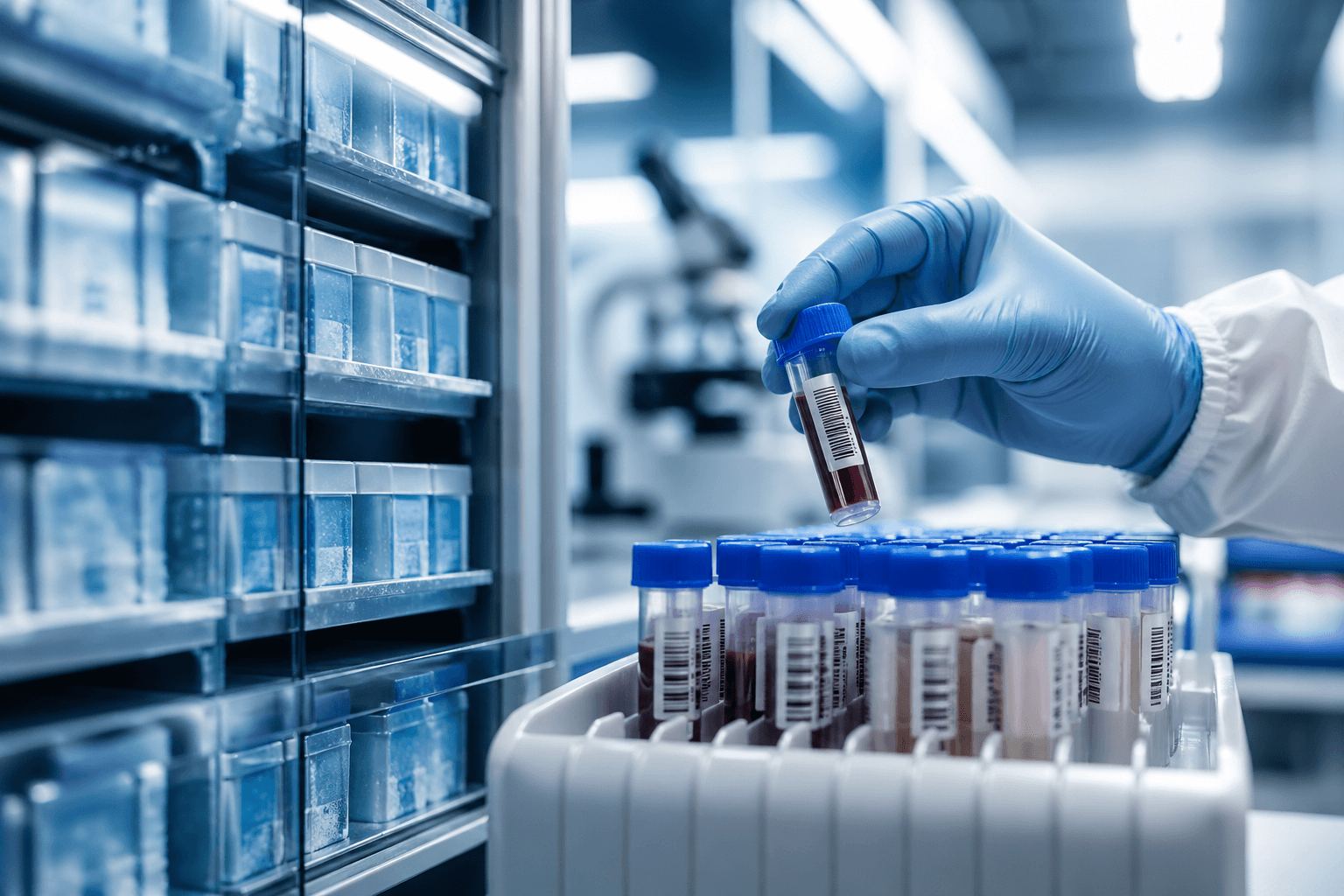
Tumor biobanking is the preservation of your tumor tissue (sometimes alive, sometimes frozen, sometimes chemically fixed) so that it can be tested and retested over time as new treatment options, clinical trials, and scientific tools emerge. It is the practice of keeping your biology available to you, rather than letting it be discarded or locked inside a hospital system after surgery.
Why the Concept Exists
Cancer medicine is undergoing a fundamental shift. For decades, the guiding question was: "What is the standard protocol for this type of cancer?" Treatment was organized around category (breast cancer, lung cancer, colorectal cancer), and most patients with the same diagnosis received the same or similar regimens.
That model is giving way to something more precise: understanding what this specific tumor, in this specific person, will respond to. Tumors of the same named type can differ enormously at the molecular level. Two patients with the same diagnosis may harbor mutations that make their cancers behave, and respond to drugs, in completely different ways.
This shift toward precision oncology depends entirely on tissue. Researchers and oncologists need enough of it, in the right form, preserved at the right time. Once a tumor is removed, that window closes. Tissue that is discarded, lost, or degraded cannot be recovered. Biobanking is the infrastructure that keeps that window open.
What "Preservation" Actually Means
Not all preserved tissue is the same. The method of preservation determines what the tissue can be used for, and different modalities have different futures. There are three primary methods.
Cryopreservation (Living Cells)
Cryopreservation involves cooling cells to ultra-low temperatures in a way that keeps them biologically viable. The goal is to suspend the cells (not kill them) so they can be revived later. When done correctly, cryopreserved tumor cells can be thawed and cultured weeks, months, or years after collection.
This form of preservation is essential for applications that require living tissue. Organoid models (miniature, lab-grown replicas of a patient's tumor) can only be built from living cells. Drug sensitivity testing, which exposes tumor cells directly to different treatment compounds to measure response, also requires viable cells. Cryopreservation is the most demanding modality to execute well, but it enables the most dynamic uses.
Flash Freezing (Molecular Snapshot)
Flash freezing snap-freezes tissue almost instantaneously, preserving its molecular state at the moment of collection. Unlike cryopreservation, the goal is not to keep cells alive. It is to stop all biological processes immediately so that the molecular contents (DNA, RNA, proteins, metabolites) are captured exactly as they were.
This format is the foundation of genomic, proteomic, and metabolomic analysis. Whole-genome sequencing, RNA expression profiling, and other deep molecular studies rely on flash-frozen samples. As our understanding of cancer biology deepens, flash-frozen archives become more valuable over time, because new analytical tools can extract information from them that we could not have extracted at the time of collection.
FFPE (Formalin-Fixed, Paraffin-Embedded)
FFPE is the format hospitals have used for decades. Tissue is fixed in formalin to stop degradation, then embedded in paraffin wax, allowing it to be sliced into thin sections and examined under a microscope. FFPE samples are durable and can be stored at room temperature for years.
This is what your hospital's pathology department keeps. FFPE is suitable for standard genetic tests and traditional pathology review. However, formalin fixation chemically alters the tissue in ways that limit its usefulness for some modern analyses. It cannot support live-cell applications, and certain molecular studies (particularly those requiring intact RNA) are constrained by the fixation process.
Each modality opens different doors. A comprehensive biobank holds all three.
What Biobanking Is Not
It helps to be clear about what tumor biobanking is not, because several misconceptions circulate.
Biobanking is not simply the pathology slide your hospital keeps on file. That slide serves a narrow diagnostic purpose. It is not owned by you, it may not be stored long-term, and it cannot serve as a foundation for personalized downstream testing.
Biobanking is not keeping your tumor for sentimental or observational reasons. A biobank is a functional scientific resource, not a keepsake. The tissue is preserved specifically so it can be used: analyzed, tested, cultured, studied.
Biobanking is not cryogenic body or head preservation. That is an entirely different field with no clinical overlap. Tumor biobanking is a practical, established scientific practice used by research institutions worldwide. It is grounded in standard laboratory methods.
At its core, biobanking is an active, ongoing resource. It is maintained, cataloged, and held ready, so that when a new question arises, the material needed to answer it already exists.
The Hospital vs. Custodial Biobank Difference
When a tumor is removed during surgery, a portion goes to the hospital's pathology department. Pathologists examine it to confirm diagnosis, assess margins, and stage the cancer. This is a clinical function, and the hospital keeps what it needs for that function: typically an FFPE block and a set of slides.
The rest of the tissue is often discarded. What remains may be stored for a limited period (retention policies vary by institution), but the tissue is held under institutional ownership, for institutional purposes. You may not be able to request it back. You may not know it exists.
A custodial biobank operates differently. Its purpose is to preserve tissue on your behalf, under your ownership, in multiple formats. The material is collected at or near the time of surgery and processed immediately to maximize quality. You retain access and control over it. If you want a sample sent to a research institution, a clinical trial sponsor, or a testing lab, you can authorize that. The relationship is between you and your biology, not between your hospital and a pathology archive.
Why It Matters for You
Cancer treatment options change faster than they ever have. Therapies that did not exist two years ago are now standard of care for certain tumor types. Clinical trials are opening continuously, and eligibility for many of them requires tumor tissue, often in specific formats and quantities that a standard hospital pathology file cannot provide.
Patients who preserved their tissue at the time of surgery have that material available when a new option emerges. Patients who did not preserve it have no practical path to obtain it later. The tumor is gone. What was not banked cannot be recovered.
Personalized testing is another consideration. Organoid-based drug sensitivity testing, which involves growing a miniature replica of your tumor and exposing it to different compounds, requires cryopreserved, living cells collected at surgery. This is not something that can be done retroactively. The opportunity exists only in that window around the initial procedure.
For patients navigating a cancer diagnosis, the future is uncertain. What is certain is that preserved tissue keeps more options on the table. It is not a guarantee of any particular outcome, but it is a resource that cannot be created after the fact.
The Bottom Line
Tumor biobanking is an insurance policy for optionality. It does not change your diagnosis, and it does not prescribe a treatment. What it does is preserve your ability to act on whatever comes next: whether that is a new clinical trial, a personalized testing approach, or an emerging therapy that does not yet exist. The science of cancer is advancing rapidly. Biobanking is the decision to keep pace with it, rather than be limited by what was possible at the moment of surgery.
Kernis Health provides concierge coordination and tissue preservation services. This article is informational, not medical advice. Decisions about your care should be made with your oncology team.
Own your biology.
If you or someone you love is preparing for cancer surgery, the best time to plan for tissue preservation is now. Talk to our team and learn what your options are.
Get Started