
What Are Organoids and How Can They Help Find Your Treatment
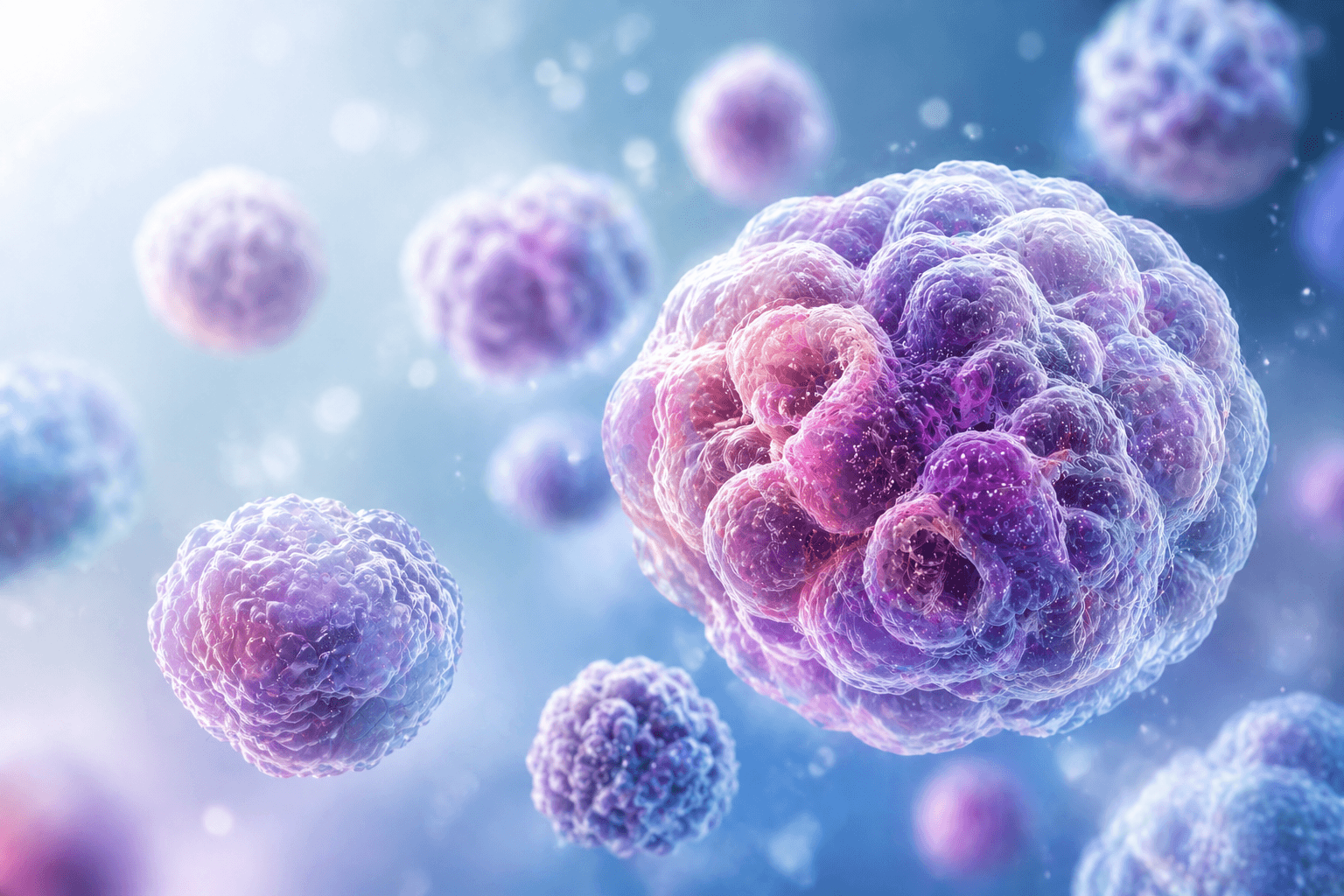
A cancer organoid is a miniature, three-dimensional tumor grown in a laboratory from your own preserved cells: a small-scale replica of your tumor that researchers can study, stress-test, and expose to drugs without touching you.
Why Organoids Are Interesting
For decades, the dominant tool for studying cancer cells in the lab was the flat culture: cells spread across the bottom of a dish in a thin, two-dimensional layer. Flat cultures are simple to maintain and useful for basic research, but they have a fundamental problem. Real tumors are not flat. They are three-dimensional structures with internal architecture, varied cell types, and complex interactions between neighboring cells and the surrounding tissue environment. When you force tumor cells to grow flat, they lose much of the biology that makes them behave the way they do inside a person.
Organoids solve this by letting cells grow in three dimensions, suspended in a gel-like matrix that mimics the physical conditions of living tissue. As the cells proliferate, they self-organize, forming structures that replicate the spatial arrangements, layering, and cell-to-cell signaling found in the original tumor. Organoids preserve heterogeneity, meaning they contain the same mixture of cell subtypes present in the source tissue, including cells that may respond differently to the same drug.
The practical result is that cancer organoids behave more like real tumors than flat cultures do. They grow, they develop resistance, they respond to drugs in patterns that more closely mirror what researchers and oncologists observe clinically. That biological fidelity is what makes them valuable as a research and testing tool.
How an Organoid Is Made from Your Tissue
The starting material for a cancer organoid is living tumor tissue collected at the time of surgery or biopsy. This is the critical dependency: the cells must be viable. Tissue that has been fixed in formalin, flash-frozen for molecular analysis, or simply left at room temperature for too long cannot be used. Organoid development requires cells that are alive and capable of dividing.
When viable tissue is cryopreserved correctly (processed quickly, treated with a protective agent that prevents ice-crystal damage, and stored at ultra-low temperatures), the cells can be thawed weeks, months, or even years later and returned to a living state. The thawed cells are then placed into a culture system designed to support three-dimensional growth. This typically involves embedding the cells in a protein-rich matrix and adding a precisely formulated growth medium that provides the nutrients, signaling molecules, and growth factors the cells need to proliferate.
Over the course of days to weeks, the cells divide and self-organize into microscopic tumor-like structures: the organoids. These structures can reach the size of a small pinhead, visible under a microscope as spherical or irregular clusters. Once established, an organoid culture can be expanded, split into multiple copies, and used across different experiments simultaneously. A single biobanked tissue sample can, in principle, support multiple rounds of testing over an extended period.
What Organoids Can Test
The most immediate application of cancer organoids is drug response testing. Researchers expose organoid cultures to individual compounds or combinations and measure how the cells respond: whether they die, slow their growth, or continue proliferating unaffected. Because the organoids come from your tissue, the responses reflect the biology of your specific tumor, not a generic cancer cell line.
Organoids are also used to study resistance mechanisms. Tumors that initially respond to a drug frequently develop ways to survive it. Growing organoids in the presence of a treatment agent allows researchers to observe how the cells adapt, which molecular pathways become active, and what secondary vulnerabilities may emerge. This information can inform thinking about sequencing therapies or combining them to forestall resistance.
Combination therapy is another active area of organoid research. Testing how two or three agents interact in a tumor-derived model is far more complex in a patient than in a controlled lab setting. Organoids allow that complexity to be explored systematically. Organoids are also increasingly relevant to clinical trial eligibility: some trials require biomarker confirmation or functional evidence before enrollment, and organoid data may contribute to that profile.
What They Can't Do
Organoids are models, not replicas. The distinction matters, particularly for patients trying to understand what this technology can realistically offer.
A cancer organoid does not contain the immune system. It does not capture the influence of the tumor microenvironment: the surrounding blood vessels, immune cells, fibroblasts, and signaling molecules that profoundly shape how a real tumor behaves and how it responds to immunotherapy in particular. Results from organoid testing reflect what happens in an isolated, controlled system, not inside a living body.
Organoid cultures can also fail to establish. Not every tissue sample yields a successful culture. Cell viability at collection, the specific cancer type, and technical factors in the culture process all affect whether organoids grow. For these reasons, organoid-based drug response data is informative (it adds a layer of biological evidence), but it is not definitive. It is one input into a clinical decision, not a substitute for it.
What This Means for Patients
The practical implication for anyone navigating a cancer diagnosis is straightforward: if organoid-based testing is something you want available to you, now or at any point in the future, you need living tissue preserved at the time of your surgery or biopsy. That window is not renewable. Once the procedure is complete and unpreserved tissue has been discarded or fixed, the option closes.
Cryopreserved cells stored in a custodial biobank remain available for organoid development whenever the need arises: during initial treatment planning, at recurrence, or when a new clinical trial or research program becomes relevant. The value of that preserved material often only becomes clear after the fact, when a new question emerges that the tissue could answer.
Planning for organoid access is a decision about keeping options open, not a commitment to any particular use. The science of what organoids can do is advancing rapidly. Preserving the tissue now ensures you are positioned to benefit from whatever that science enables next.
Kernis Health provides concierge coordination and tissue preservation services. This article is informational, not medical advice. Decisions about your care should be made with your oncology team.
Own your biology.
If you or someone you love is preparing for cancer surgery, the best time to plan for tissue preservation is now. Talk to our team and learn what your options are.
Get Started